Archive

November 10, 2026

Browsing

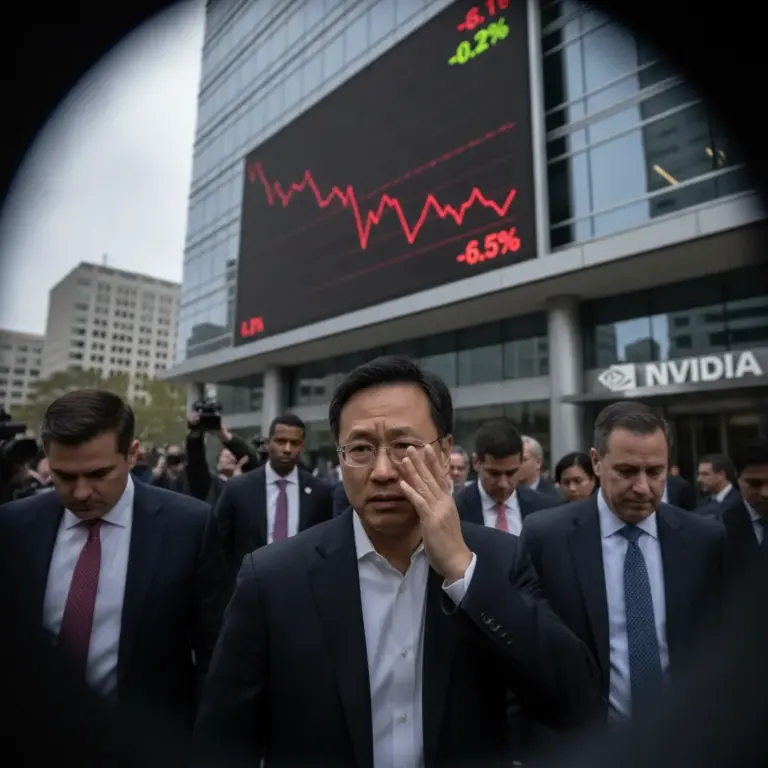
Shares of Nvidia took a sharp dive today following revelations that the company has launched an internal investigation into its chief executive, Jensen Huang. The sudden volatility comes after reports emerged linking the leadership of the world’s most prominent AI chipmaker to serious allegations involving national security and personal misconduct. Investors reacted swiftly to the uncertainty, sending shockwaves through the tech sector as market confidence wavered.

The turmoil centers on two distinct but equally damaging fronts. According to recent updates, Huang has admitted to having an affair, while simultaneously facing scrutiny over alleged connections to foreign espionage. While Nvidia remains the dominant force in providing the hardware necessary for the artificial intelligence boom, these claims have raised urgent questions about corporate governance and whether any sensitive technology was compromised during these episodes.

Industry analysts suggest that the timing could not be worse for Nvidia, which has seen its valuation skyrocket due to the global rush toward generative AI. The intersection of private scandal and potential state-level spying creates a precarious situation for a board tasked with maintaining trust among government contractors and international partners. For now, shareholders are left waiting to see if this crisis will result in a change at the top or if Huang can navigate his way out of the storm.


When the stock market takes a sudden dive, the instinct for many investors is to jump ship before things get worse. However, legendary investor Peter Lynch once warned that far more money is lost by people trying to anticipate corrections than is actually lost during the corrections themselves. Writing decades ago, Lynch emphasized a simple but difficult truth: the most critical part of building wealth is simply staying invested in stocks, regardless of the short term noise.

This lesson feels particularly relevant following a volatile week where the S&P 500 saw significant drops and investors began bracing for upcoming inflation reports and potential Federal Reserve rate hikes. For retirees, these swings can feel catastrophic, especially when looking at thousands of dollars vanishing from an account in a matter of days. Yet historical data suggests that attempting to time the bottom is largely a fool’s errand. Analysis showing investments made over several decades reveals that while perfect timing yields slightly higher returns, the difference between the luckiest buyer and the unluckiest one is relatively small compared to the risk of being out of the market entirely.

For those living on their savings, the secret to weathering these storms isn’t selling stocks, but rather managing cash flow. By maintaining a sufficient cushion of bonds and cash—enough to cover several years of living expenses—investors can avoid being forced to sell shares while prices are low. Instead of reacting to weekly volatility, savvy planners focus on locking in guaranteed yields through Treasuries and utilizing market dips for strategic moves, such as converting traditional IRA funds into Roth accounts while asset values are temporarily lowered.

Ultimately, the goal during a downturn is to shift perspective from daily point losses to long term sustainability. While headlines often scream about impending crashes, history shows that markets typically recover and reach new records within a few months_ In an environment defined by uncertainty, sticking to a disciplined plan proves far more profitable than chasing the phantom promise of perfect timing.

The American labor market showed renewed strength in October as employers added 165,000 jobs, bringing the national unemployment rate down to 4.1 percent. According to latest data from the Labor Department, growth was particularly evident in healthcare, manufacturing, and business services, while the warehouse and transportation sector contributed another 25,000 positions. This upward trend was further bolstered by positive revisions to employment numbers from August and September, which together saw an increase of 84,000 jobs over previous estimates.

Despite these gains, the recovery is not felt evenly across all sectors. While some industries expanded, restaurants and construction firms faced contractions throughout the month. Workers also find themselves in a precarious financial position even as average wages rose by 3.1 percent compared to last year. Although this represents a slight uptick in pay increases, economists warn that salary growth is failing to keep pace with an inflation rate that hit 3.7 percent in September, largely driven by soaring energy costs linked to geopolitical tensions involving Iran.

This gap between earnings and the cost of living has created significant public friction, recently manifesting as a key driver in midterm election results where Republicans lost their majorities in both chambers of Congress. For now, the Federal Reserve continues to leverage the historically low unemployment rate as a buffer while it focuses on curbing inflation. Though interest rates remained steady last week, many investors anticipate another hike when policymakers convene again in December.

A detailed warning from a New York short selling firm is gaining fresh attention after it became clear that Nvidia CEO Jensen Huang had developed an intimate relationship with a woman now suspected of being a Chinese operative. Culper Research first sounded the alarm in May, describing the bond between Huang and Alice Huang, an executive at the Singaporean firm Megaspeed, as uncomfortably close. At the time, the report noted that employees within Nvidia were already questioning the nature of their association after seeing the pair socialize frequently.

The situation escalated over the weekend when Jensen Huang admitted to having an extramarital affair with Alice Huang, who despite sharing his surname is not a relative. In response, Nvidia has launched a formal internal investigation into the matter. US intelligence officials now suspect that Alice Huang was recruited by the Chinese government specifically to gather sensitive information on the CEO and potentially sway his views on American export restrictions regarding high end artificial intelligence chips.

Beyond the personal scandal, Culper Research had originally used its findings to suggest that Nvidia faced a systemic problem with how its technology reached China. The firm alleged that restricted chips were being diverted through Southeast Asia via Megaspeed, which they claimed was secretly funded by Alibaba through various shell companies. To support this theory, Culper highlighted a massive spike in Megaspeed’s financial liabilities, which jumped from thirty three million dollars in late 2023 to roughly three billion dollars by late 2024.

While recent reporting from the Financial Times suggests that Alibaba did indeed provide loans to Megaspeed through subsidiaries, some aspects of the short seller’s claims remain unverified. Critics point out that Culper Research stood to profit financially if Nvidia’s stock price dropped following these revelations. Nevertheless, the timing of their initial report serves as a stark reminder of how long these red flags existed before they evolved into a national security concern for US authorities.