Author

admin

Browsing

The Trump administration has proposed new tariffs of up to 12.5% on imports from 60 economies after determining they had failed to curb trade in goods ‌made with forced labor, an assertion that was rejected by its trading partners.

The proposal from the U.S. Trade Representative’s office, issued late on Tuesday, comes from a Section 301 unfair trade practices investigation designed to help rebuild U.S. President Donald Trump’s emergency tariffs, struck down by a U.S. Supreme Court decision in February.

Despite laws banning them, the products of forced labor are deeply embedded in supply chains around the world. But European lawmakers in particular bristle at the ​accusation that the region is less effective than the U.S. at curbing the trade in such goods, with one describing the U.S. findings as “utterly absurd.”

The USTR proposed 10% additional ​duties on imports from Canada, Ecuador, the European Union, Indonesia, Mexico, Pakistan, Argentina, Bangladesh, Cambodia, El Salvador, Guatemala, Malaysia, Taiwan and Britain. The USTR said ⁠all had plans or partial schemes in place.

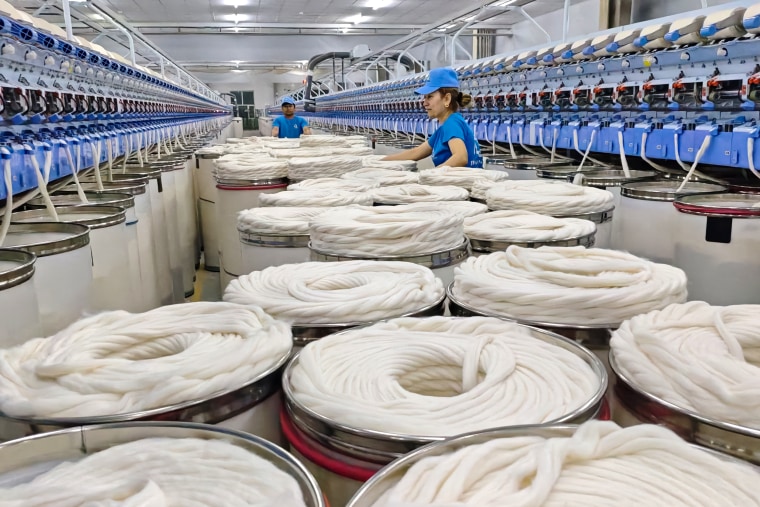
Employees work on the spinning production line at a workshop of a textile factory in Xinjiang Uygur Autonomous Region of China on March 5.Bao Liangting / VCG via Getty Images file

The trade agency said it would impose additional duties of 12.5% on the remaining 45 countries that it investigated. These include China, India, Nigeria, Japan, ​South Korea, Vietnam, Australia and New Zealand.

“The failure of our most important trading partners to address the importation of goods made with forced labor is unacceptable,” U.S. Trade Representative Jamieson Greer said in a ​statement. “This creates a dynamic where American workers are forced to compete globally on an unlevel playing field.”

The USTR said it would accept public comments on the proposed tariffs and other remedies through July 6, with a public hearing scheduled for July 7.

The announcement comes ahead of the July 24 expiration of a 10% temporary tariff imposed by the Trump administration on Feb. 20, the day the Supreme Court struck down Trump’s ​tariffs under the International Emergency Economic Powers Act.

The European Commission said the tariffs were unjustified and reiterated its commitment to the trade deal sealed with Washington last year.

Bernd Lange, the chair of the European ​Parliament’s trade committee, which voted on Tuesday to accept that trade deal, said the new tariffs were expected, but said the results of the U.S. investigation were still “utterly absurd” given a 2024 E.U. law to ban imports ‌of forced labor ⁠products.

“The impression is increasingly emerging that a tariff measure is sought first, and only then is a suitable legal justification found,” he said. However, he added that the key question would be whether the additional tariffs would exceed those agreed between both sides last July.

The U.S.’s largest trading partner, the European Union, agreed last July to accept tariffs of 15% on a broad range of its exports. In its report, the USTR said the E.U. measures came into force only in December 2027 and lacked key elements.

“We know there are ups and downs in what people say,” French Finance Minister Roland Lescure ​told reporters after a Cabinet meeting. “But the goal ​is to ratify the (trade) accord and stick ⁠to that.”

Britain said it was in regular talks with the United States and was taking action to tackle forced labor. It added that the preferential access to U.S. markets that it had negotiated for U.K. businesses remained in place.

Taiwan said it was “hopeful and confident” that the final results would reflect agreements ​already reached, securing relatively preferential treatment.

Beijing, facing 12.5% tariffs, said that it opposed all forms of unilateral tariffs and that there was no forced labor ​in China. India, confronted with ⁠the same rate, said it was engaged with Washington on the Section 301 proceedings, noting the proposed tariffs were not final.

On Monday, the USTR proposed a 25% duty on many Brazilian goods as a result of a Section 301 investigation into the country’s digital trade practices and preferential tariffs.

The trade agency is also expected to soon unveil the findings of another major Section 301 probe into the buildup of excess industrial capacity ⁠in 16 trading ​partners, including China and the European Union.

In the forced labor findings, the USTR said it would exempt from tariffs ​products including energy, rare earths and some other metals, beef, coffee, certain fruits and vegetables, pharmaceuticals, organic chemicals and aircraft parts.

It also said it was proposing a textile mechanism that would allow for a certain volume of apparel and textile imports ​to enter the U.S. at a reduced tariff rate, without giving details.

Growing up in South Florida, Jozy Altidore heard a lot of Spanish playing soccer with local kids and at home from his Dominican grandmother. As a teenager, he went to play for Villarreal, in the Castellón part of Spain, an area that isn’t that touristy. His coach and teammates mostly spoke Spanish. Along the way, Altidore picked up the language.

“A lot of people look at me like, ‘What? You speak Spanish?’” Altidore told NBC News.

It will come in handy this summer, when Altidore serves as a World Cup commentator for Telemundo, the games’ official Spanish-language network. Altidore has no experience in broadcasting, and he admits that his Spanish is just OK. But he saw the World Cup was coming to North America, and he didn’t want to be left on the sidelines.

“It’s the biggest, most historical World Cup we’ve had,” Altidore said. “For me, it was a good opportunity to stay involved, be a part of the World Cup.”

But what about his Spanish? “I can get by,” he said. “I thought, ‘What a cool challenge.’ I think you want to challenge yourself, in the things that you’re doing, always.”

Plus, he’ll get to see the Telemundo broadcast up close, the excitement of it, which is a stark contrast to the English-language telecasts, particularly the “goal” calls from the announcer Andrés Cantor. “I always wondered, how does he do that in one breath?” Altidore said. “This guy goes just the whole time. I can’t wait to see the legend in action.” (Telemundo and NBC News share a parent company, NBCUniversal.)

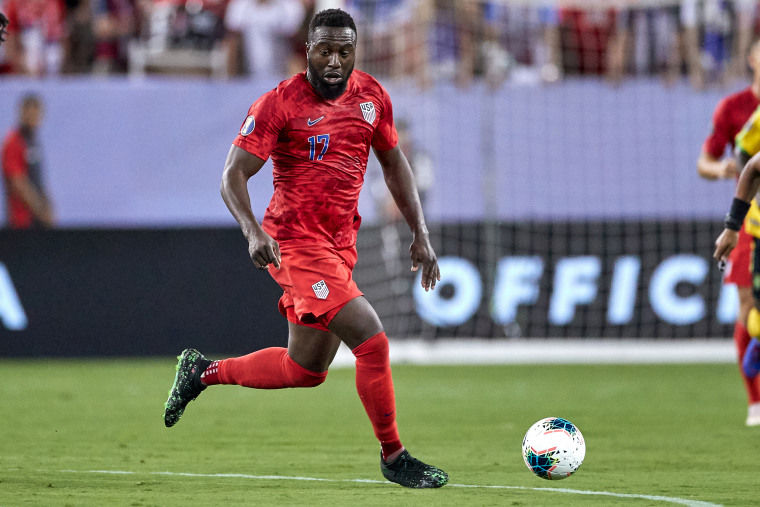
Altidore during the Gold Cup semifinal match between the U.S. and Jamaica in Nashville, Tenn., on July 3, 2019.Robin Alam / Icon Sportswire via Getty Images file

Altidore will be offering analysis and insight on Team USA’s games not far removed from his own time playing for the team. He is considered one of the best American players of the last two decades, a striker who scored 42 goals in 115 appearances. He helped the U.S. make it to the 2010 and 2014 World Cups, though he got injured during the latter tournament. He played with a few members of the 2026 roster, including Christian Pulisic.

Altidore told NBC News he has a rose-colored view of the current team. “I’m optimistic,” he said. “I’m bullish. I think this team can win the World Cup. I really do. I think they have the talent. And I’m so excited for them to get their flowers.”

Altidore understands how that sounds: Team USA? Winning the World Cup? But he pointed to past examples of host countries making deep runs in the tournament: South Korea reaching the semifinals in 2002, and Germany doing the same in 2006. Colombia also reached the quarterfinals in 2014, when the World Cup was held in neighboring Brazil.

With this World Cup being held on home soil, maybe “we’re able to push our team to a bit of a better performance than we have historically,” Altidore said.

He didn’t just mean the players — he meant the fans, too. “Can we show up in numbers in a way that, from the players’ arrival, they feel the emotion, they feel the enthusiasm, they feel the camaraderie?” Altidore said. “And we can push them on to play a little bit above themselves, to play a little bit above what we’ve seen already.”

You can sense his excitement. As a media member, Altidore will have to now learn to balance his rooting interests with offering clear-eyed analysis. “For me, it’s really getting behind these guys, applauding them for how far they’ve now taken the flag and where they’ve brought it,” he said. “But at the same time, it’s not all rainbows. You’ve got to be critical of guys, and you have to obviously critique their performances.”

Altidore was first introduced to soccer in 1994, the last time the U.S. hosted the World Cup, when he was just a young boy. His father recorded games on VHS tapes. He imagines lots of families will do the same this summer, three decades later, albeit with updated technology.

“They’re going to get exposed to soccer in a wonderful way for the first time, and it’s going to birth soccer players, it’s going to birth soccer fans, soccer enthusiasts,” Altidore said.

He’ll be doing his part, by showing his enthusiasm on the Telemundo broadcasts. “It’s more than just X’s and O’s in my opinion,” Altidore said. “This is a very good opportunity to continue growing the game for another 30, 40 years to come.”

Federal Reserve Governor Jerome Powell warned Sunday about the impact of a politicized Fed and made a broader call for the defense ‌of democratic institutions in his first public remarks since the end of his eight-year stint as head of the central bank.

“Democratic institutions take much time, effort, and patience to build but can be torn down all too quickly,” Powell said in remarks ​prepared for delivery as he accepted the John F. Kennedy Profile in Courage Award, given by ​the John F. Kennedy Library Foundation.

“It is essential that we preserve what is good about ⁠these institutions, even as we strive to improve them,” said Powell, who included the Fed along with the ​courts and universities as among the core institutions key to the country’s success and standing in the world.

“Like ​many other institutions, the Fed has been undergoing a stress test,” Powell said, which in the central bank’s case has included efforts by President Donald Trump to fire Fed Governor Lisa Cook, calls for Powell’s resignation and a criminal probe of Powell.

Powell’s ​term as chair formally ended on May 15. His successor, Kevin Warsh, was sworn in as Fed chair on ​May 22. Powell has decided to continue as a Fed governor in part because of what he regards as ongoing threats ‌to ⁠the Fed’s independence, a decision that effectively prevents Trump from appointing another member to the Fed board for now.

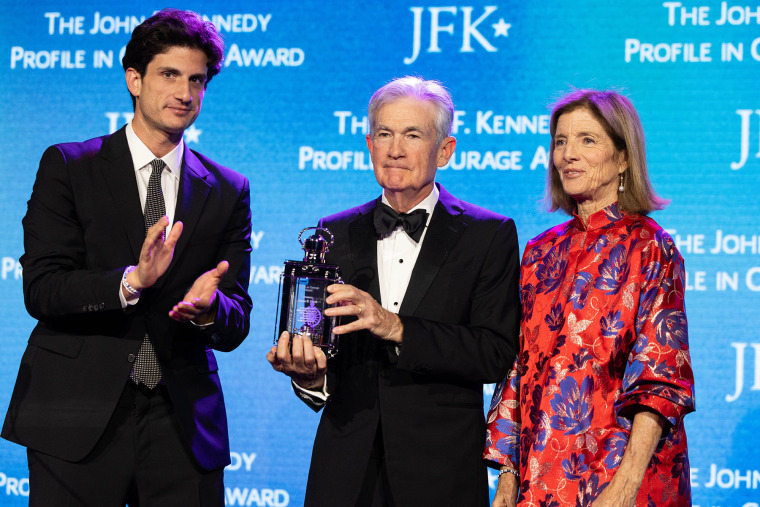
Jerome Powell with Caroline Kennedy and Jack Schlossberg after receiving the Profile in Courage Award.Scott Eisen / Getty Images

The Fed’s structure is meant to allow it to make monetary policy decisions free of political considerations, and “these protections have served the public well, and administrations from both parties have respected them,” Powell said. “If any administration finds a ​way to remove Fed officials ​over policy differences, then ⁠future administrations will do so as well. The public would lose faith that the central bank will make decisions based only on what’s best for all Americans.”

In ​announcing the award to Powell earlier this year, the foundation said he had “safeguarded one ​of the country’s ⁠most essential apolitical institutions and demonstrated extraordinary courage in the face of sustained personal and professional risk.”

The award this year was also given to the citizens of Minneapolis and St. Paul for the public response to the surge ⁠in immigration ​enforcement in the Twin Cities area, including protests and efforts to monitor ​government enforcement efforts.

Major League Baseball owners made their long-expected salary cap proposal to the players’ association on Thursday, a system the union has vowed never to accept, setting the sides on course for a confrontation that threatens the 2027 season and perhaps beyond.

Baseball owners hadn’t proposed a firm cap since 1994. Their effort prompted a 7 1/2-month strike that forced the cancellation of the World Series for the first time in 90 years.

MLB’s proposal would cap spending in 2027 at $245.3 million, using figures for luxury tax payrolls that include benefits and the pre-arbitration bonus pool, and establish a payroll floor of $171.2 million. The Los Angeles Dodgers, baseball’s biggest spenders, had a $415.2 million payroll on opening day this year — around $170 million over the proposed cap.

Owners said they would discuss a phase-in schedule that would give teams like the Dodgers time to comply with the cap and an escrow system with the union as part of a proposed seven-year deal, that all current contracts would remain guaranteed and there would be no prohibition of guaranteed contracts under the cap system.

MLB said it would centralize local media revenue from the 30 teams equally and give players a 50-50 split as part of a proposal that would eliminate the current revenue-sharing plan among the clubs.

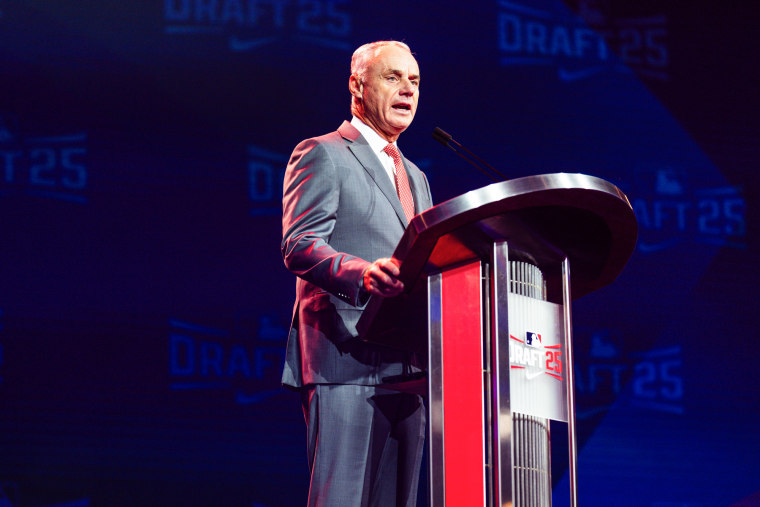
Major League Baseball Commissioner Rob Manfred.Matthew Grimes Jr. / Atlanta Braves via Getty Images file

“Our salary cap and floor proposal levels the playing field while sharing baseball revenue with the players 50/50 as we grow the game together,” MLB spokesman Glen Caplin said in a statement. “Further, by sharing media revenue equally as part of our proposal, we can address another top fan concern of local TV blackouts.”

Baseball’s current five-year deal, agreed to in March 2022 after a 99-day lockout, expires Dec. 2. While a lockout next winter is expected, talks are not likely to intensify until late February or early March 2027, when the possibilities of losing regular-season games and revenue near. If regular-season games are lost, negotiations may become a standoff of which side can tolerate the most economic loss.

Based on 2026 opening day figures, eight teams would have to cut payroll to get under the cap. The teams over are the two-time reigning World Series champion Dodgers, New York Mets ($379.2 million), New York Yankees ($339.6 million), Toronto ($319.5 million), Philadelphia ($315.2 million), Boston ($263.7 million), San Diego ($260.1 million) and Atlanta ($247.9 million).

Twelve teams would be required to increase payroll by a total of $617 million based on 2026 numbers: Miami ($81.8 million), Cleveland ($95.7 million), Tampa Bay ($108.2 million), the Chicago White Sox ($108.6 million), St. Louis ($114.4 million), Washington ($119.1 million), Pittsburgh ($122.6 million), Minnesota ($125.6 million), Milwaukee ($130.9 million), the Athletics ($139.2 million), Colorado ($142.2 million) and Cincinnati ($148.8 million).

Owners and the union agreed to a luxury tax in 2003 designed to slow spending, but teams feel it has had little or no impact on the Dodgers and Mets in recent years. The last small-market MLB club to win a World Series was Kansas City in 2015, although Cleveland, Tampa Bay and Milwaukee all lead their divisions as of Thursday, while the Mets and Red Sox are in last place.

MLB said its revenue has grown by 247% since 2003 and player payroll has increased by 149% in that span.

Management gave the union its latest plan during a bargaining session at the commissioner’s office, one day after the union made its economic proposal. Owners say a cap is needed to improve competitive balance and restrain wealthy teams from assembling starrier rosters than their smaller-market brethren.

Players want expanded free agency and salary arbitration rights along with almost doubling the major league minimum, increasing the money high-revenue teams share with the less-wealthy clubs and establishing penalties for teams that drop below payroll floors.

Aaron Judge of the U.S. leads teammates onto the field before game against Venezuela in the World Series of Baseball in Miami on March 17.Megan Briggs / Getty Images file

Other U.S. major sports leagues operate under a cap. The NBA had a cap in its initial season in 1946-47, then dropped that and began its modern version in 1984-85. NFL players and owners adopted a cap for the 1994 season, and the NHL did so in 2005-06 after a lockout wiped out the entire 2004-05 season.

The Dodgers shattered MLB’s spending record with a combined $515 million in payroll and luxury tax last year en route to their second straight World Series title. Los Angeles’ total was seven times the $68.7 million payroll of the Marlins, the lowest-spending team, and more than the payrolls of the bottom six clubs combined.

Players say a cap would hurt them and enrich owners, and they say they will never agree to one. Without a cap, MLB stars have landed lucrative, guaranteed contracts that outpace what the biggest stars in other U.S. sports leagues make. Juan Soto’s $765 million, 15-year contract with the Mets is believed to be the biggest ever in team sports and is far greater than the largest deals in the NFL (Patrick Mahomes at $450 million over 10 years) and NBA (Jayson Tatum at $314 million over five years).

MLB’s last salary cap proposal in 1994 offered players a 50-50 split of revenue in a system that would have forced teams to maintain payrolls of 84%-110% of the average. Salary arbitration would have been eliminated and the threshold for free agency would have been lowered from six years’ major league service to four — with the provision that a player’s former club could match any offer until he had six years.

MLB’s offer came on June 14 that year, and players struck on Aug. 12. MLB withdrew the cap proposal the following Feb. 6 after pressure by the National Labor Relations Board. The strike ended on March 31 after U.S. District Judge Sonia Sotomayor — now a Supreme Court justice — issued an injunction restoring the work rules of the expired labor contract. Two days later, owners accepted the union’s offer to return to work without an agreement. A deal wasn’t reached until 1997.

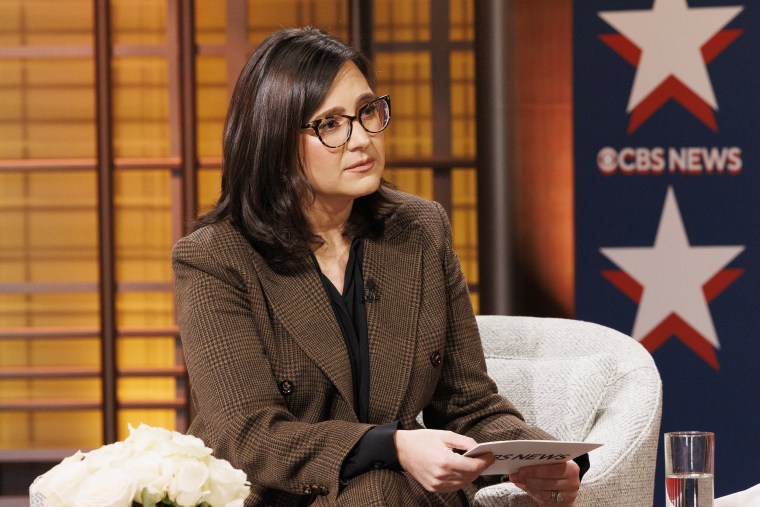
CBS News has reportedly declined to renew its contract with Sharyn Alfonsi, the “60 Minutes” correspondent whose segment about the Trump administration deporting Venezuelan men to a prison in El Salvador was abruptly pulled off the air late last year.

Alfonsi confirmed the expiration of her CBS News deal in an interview with The New York Times published Wednesday. CBS News and Alfonsi did not immediately respond to NBC News’ requests for comment on the matter.

“It sends a chilling message to the entire newsroom,” Alfonsi told the Times. “I think it was a deliberate choice to penalize a journalist for refusing to sanitize accurate reporting.”

“60 Minutes” ultimately aired Alfonsi’s segment in January after a last-minute postponement in late December that the correspondent had claimed was “not an editorial decision” but “a political one.”

The segment featured interviews with men who were deported from the U.S. to the Center for the Confinement of Terrorism, or CECOT, in Tecoluca, El Salvador. The interviewees described torture and physical and sexual abuse at the complex.

In an editorial call Dec. 22, the morning after “Inside CECOT” was pulled from the “60 Minutes” lineup, CBS News Editor-in-Chief Bari Weiss said she had held the story “because it was not ready,” according to a source.

CBS News Editor-in-Chief Bari Weiss moderates a town hall with Erika Kirk on Dec. 10.CBS via Getty Images file

“While the story presented powerful testimony of torture at CECOT, it did not advance the ball — the Times and other outlets have previously done similar work,” Weiss told CBS News staffers, according to that source.

Weiss is a former opinion writer and editor at the Times who launched the website The Free Press in 2021. Paramount Skydance, which owns CBS, acquired The Free Press and hired Weiss as editor-in-chief of CBS News in October.

Alfonsi, who made her “60 Minutes” debut in 2015, continued to appear on the newsmagazine through the end of its 58th season, which concluded May 17.

She is the second “60 Minutes” correspondent to exit the show since Weiss became top editor at CBS News, following Anderson Cooper, who signed off this month after 20 years on the broadcast.

In a farewell message that aired this month, Cooper said in part: “The independence of ‘60 Minutes’ has been critical, and I think the trust it has with viewers is critical to the success of ‘60 Minutes.’”

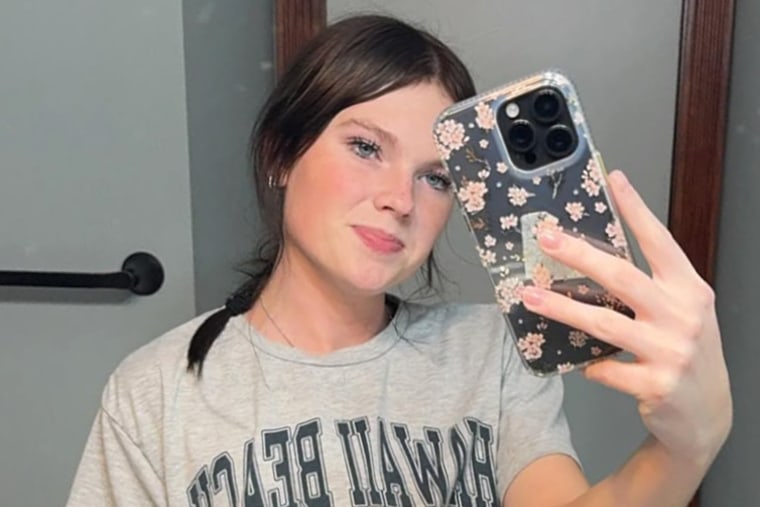
MIAMI — A federal judge on Wednesday declined to jail a Florida teenager accused of killing and sexually assaulting his stepsister, allowing him to remain in the custody of a family member while he awaits trial.

Timothy Hudson, 16, has been free since the slaying of Anna Kepner, who died on Nov. 7, 2025, aboard a Carnival cruise ship. At the time he was arrested and charged as a juvenile and allowed to live with an uncle because of his age. But in April a federal grand jury indicted him as an adult, introducing the possibility that he could be jailed as he awaits trial.

“If it were a 20-year-old under the exact circumstances I probably would have detained,” U.S. District Judge Edwin Torres said. “The presumption would be we were just not going to take that chance.”

“This is a different animal,” Torres said.

Anna Kepner.anna.kepner16 via Instagram

Torres took into consideration that detaining Hudson in Miami-Dade County — where he was charged — would make it difficult for his family, which lives hundreds of miles away in Hernando County, to visit him.

The judge said he wanted to “know what my options are” about potentially detaining Hudson closer to home before deciding to hold him behind bars.

Alejandra Lopez, a lawyer for the government, argued that Hudson is “a danger to the community” and questioned how authorities can trust “this defendant won’t act again.”

She noted that two minors live in Hudson’s uncle’s home, where he is residing.

“What is needed to prove a danger? A second dead body?” she asked.

Evan Kuhl, a public defender representing Hudson, argued that his client is not a danger to the public or a flight risk because he has abided by the conditions of his release for several months without any incidents.

Lopez shot back that it took months after Kepner’s death for officials to charge Hudson because authorities were gathering evidence.

“How is he going to be a risk of flight if he doesn’t even know if he’s going to be charged?” she asked. “That doesn’t make sense.”

Hudson is only allowed to leave his house with his uncle or aunt and will be electronically monitored by authorities.

Anna Kepner’s car, decorated by her classmates at Temple Christian School, remained in the school parking lot in Titusville, Fla., for weeks after her death. Malcolm Denemark / USA Today Network via Imagn

The November cruise vacation included the victim’s father, stepmother and two of her children, including Hudson. Kepner’s father and Hudson’s mother married in December 2024.

Kepner’s body was found wrapped in a blanket, bruised and under a bed in her room, concealed by life vests. Her death was ruled a homicide caused by “mechanical asphyxiation,” according to the Miami-Dade medical examiner.

The girl and her stepbrother were sharing a room on the cruise, according to Hudson’s father’s lawyer.

The teenager was arrested while the ship was in international waters en route to Miami. He was hospitalized upon the ship’s docking and has since been in counseling, according to a lawyer for his mother.

On the day Hudson’s indictment was made public, Chris Kepner — Anna Kepner’s father and Hudson’s stepfather — declared that “justice needs to be served.”

Kepner was a high school senior and cheerleader, with hopes of cheerleading for the University of Georgia. She was remembered in her obituary for lacking a filter and being “bubbly, funny, outgoing, and completely herself.” At the time, her family said that “in true Anna fashion, the family would like everyone to know there is no GoFundMe” for her funeral. She was set to graduate from high school this spring.

Hudson’s trial could begin in September, Lopez said Wednesday.

The S&P 500 ($SPX) just logged its fifth straight trading box breakout, which means that, of the five trading ranges the index has experienced since the April lows, all have been resolved to the upside.

How much longer can this last? That’s been the biggest question since the massive April 9 rally. Instead of assuming the market is due to roll over, it’s been more productive to track price action and watch for potential changes along the way. So far, drawdowns have been minimal, and breakouts keep occurring. Nothing in the price action hints at a lasting change — yet.

While some are calling this rally “historic,” we have a recent precedent. Recall that from late 2023 through early 2024, the index had a strong start and gave way to a consistent, steady trend.

From late October 2023 through March 2024, the S&P 500 logged seven consecutive trading box breakouts. That streak finally paused with a pullback from late March to early April, which, as we now know, was only a temporary hiccup. Once the bid returned, the S&P 500 went right back to carving new boxes and climbing higher.

New 52-Week Highs Finally Picking Up

If there’s been one gripe about this rally, it’s that the number of new highs within the index has lagged. As we’ve discussed before, among all the internal breadth indicators available, new highs almost always lag — that’s normal. What we really want to see is whether the number of new highs begins to exceed prior peaks as the market continues to rise, which it has, as shown by the blue line in the chart below.

As of Wednesday’s close, 100 S&P 500 stocks were either at new 52-week highs or within 3% of them. That’s a strong base. We expect this number to continue rising as the market climbs, especially if positive earnings reactions persist across sectors.

Even when we get that first day with 100+ S&P 500 stocks making new 52-week highs, though, it might not be the best time to initiate new longs.

The above chart shows that much needs to align for that many stocks to peak in unison, which has historically led to at least a short-term consolidation, if not deeper pullbacks — as highlighted in yellow. Every time is different, of course, but this is something to keep an eye on in the coming weeks.

Trend Check: GoNoGo Still “Go”

The GoNoGo Trend remains in bullish mode, with the recent countertrend signals having yet to trigger a greater pullback.

Active Bullish Patterns

We still have two live bullish upside targets of 6,555 and 6,745, which could be with us for a while going forward. For the S&P 500 to get there, it will need to form new, smaller versions of the trading boxes.

Failed Bearish Patterns

In the chart below, you can view a rising wedge pattern on the recent price action, the third since April. The prior two wedges broke down briefly and did not lead to a major downturn. The largest pullbacks in each case occurred after the S&P 500 dipped below the lower trendline of the pattern.

The deepest drawdown so far is 3.5%, which is not exactly a game-changer. Without downside follow-through, a classic bearish pattern simply can’t be formed, let alone be broken down from.

We’ll continue to monitor these formations as they develop because, at some point, that will change.

The S&P 500 ($SPX) just logged its fifth straight trading box breakout, which means that, of the five trading ranges the index has experienced since the April lows, all have been resolved to the upside.

How much longer can this last? That’s been the biggest question since the massive April 9 rally. Instead of assuming the market is due to roll over, it’s been more productive to track price action and watch for potential changes along the way. So far, drawdowns have been minimal, and breakouts keep occurring. Nothing in the price action hints at a lasting change — yet.

While some are calling this rally “historic,” we have a recent precedent. Recall that from late 2023 through early 2024, the index had a strong start and gave way to a consistent, steady trend.

From late October 2023 through March 2024, the S&P 500 logged seven consecutive trading box breakouts. That streak finally paused with a pullback from late March to early April, which, as we now know, was only a temporary hiccup. Once the bid returned, the S&P 500 went right back to carving new boxes and climbing higher.

New 52-Week Highs Finally Picking Up

If there’s been one gripe about this rally, it’s that the number of new highs within the index has lagged. As we’ve discussed before, among all the internal breadth indicators available, new highs almost always lag — that’s normal. What we really want to see is whether the number of new highs begins to exceed prior peaks as the market continues to rise, which it has, as shown by the blue line in the chart below.

As of Wednesday’s close, 100 S&P 500 stocks were either at new 52-week highs or within 3% of them. That’s a strong base. We expect this number to continue rising as the market climbs, especially if positive earnings reactions persist across sectors.

Even when we get that first day with 100+ S&P 500 stocks making new 52-week highs, though, it might not be the best time to initiate new longs.

The above chart shows that much needs to align for that many stocks to peak in unison, which has historically led to at least a short-term consolidation, if not deeper pullbacks — as highlighted in yellow. Every time is different, of course, but this is something to keep an eye on in the coming weeks.

Trend Check: GoNoGo Still “Go”

The GoNoGo Trend remains in bullish mode, with the recent countertrend signals having yet to trigger a greater pullback.

Active Bullish Patterns

We still have two live bullish upside targets of 6,555 and 6,745, which could be with us for a while going forward. For the S&P 500 to get there, it will need to form new, smaller versions of the trading boxes.

Failed Bearish Patterns

In the chart below, you can view a rising wedge pattern on the recent price action, the third since April. The prior two wedges broke down briefly and did not lead to a major downturn. The largest pullbacks in each case occurred after the S&P 500 dipped below the lower trendline of the pattern.

The deepest drawdown so far is 3.5%, which is not exactly a game-changer. Without downside follow-through, a classic bearish pattern simply can’t be formed, let alone be broken down from.

We’ll continue to monitor these formations as they develop because, at some point, that will change.

The S&P 500 ($SPX) just logged its fifth straight trading box breakout, which means that, of the five trading ranges the index has experienced since the April lows, all have been resolved to the upside.

How much longer can this last? That’s been the biggest question since the massive April 9 rally. Instead of assuming the market is due to roll over, it’s been more productive to track price action and watch for potential changes along the way. So far, drawdowns have been minimal, and breakouts keep occurring. Nothing in the price action hints at a lasting change — yet.

While some are calling this rally “historic,” we have a recent precedent. Recall that from late 2023 through early 2024, the index had a strong start and gave way to a consistent, steady trend.

From late October 2023 through March 2024, the S&P 500 logged seven consecutive trading box breakouts. That streak finally paused with a pullback from late March to early April, which, as we now know, was only a temporary hiccup. Once the bid returned, the S&P 500 went right back to carving new boxes and climbing higher.

New 52-Week Highs Finally Picking Up

If there’s been one gripe about this rally, it’s that the number of new highs within the index has lagged. As we’ve discussed before, among all the internal breadth indicators available, new highs almost always lag — that’s normal. What we really want to see is whether the number of new highs begins to exceed prior peaks as the market continues to rise, which it has, as shown by the blue line in the chart below.

As of Wednesday’s close, 100 S&P 500 stocks were either at new 52-week highs or within 3% of them. That’s a strong base. We expect this number to continue rising as the market climbs, especially if positive earnings reactions persist across sectors.

Even when we get that first day with 100+ S&P 500 stocks making new 52-week highs, though, it might not be the best time to initiate new longs.

The above chart shows that much needs to align for that many stocks to peak in unison, which has historically led to at least a short-term consolidation, if not deeper pullbacks — as highlighted in yellow. Every time is different, of course, but this is something to keep an eye on in the coming weeks.

Trend Check: GoNoGo Still “Go”

The GoNoGo Trend remains in bullish mode, with the recent countertrend signals having yet to trigger a greater pullback.

Active Bullish Patterns

We still have two live bullish upside targets of 6,555 and 6,745, which could be with us for a while going forward. For the S&P 500 to get there, it will need to form new, smaller versions of the trading boxes.

Failed Bearish Patterns

In the chart below, you can view a rising wedge pattern on the recent price action, the third since April. The prior two wedges broke down briefly and did not lead to a major downturn. The largest pullbacks in each case occurred after the S&P 500 dipped below the lower trendline of the pattern.

The deepest drawdown so far is 3.5%, which is not exactly a game-changer. Without downside follow-through, a classic bearish pattern simply can’t be formed, let alone be broken down from.

We’ll continue to monitor these formations as they develop because, at some point, that will change.

The S&P 500 ($SPX) just logged its fifth straight trading box breakout, which means that, of the five trading ranges the index has experienced since the April lows, all have been resolved to the upside.

How much longer can this last? That’s been the biggest question since the massive April 9 rally. Instead of assuming the market is due to roll over, it’s been more productive to track price action and watch for potential changes along the way. So far, drawdowns have been minimal, and breakouts keep occurring. Nothing in the price action hints at a lasting change — yet.

While some are calling this rally “historic,” we have a recent precedent. Recall that from late 2023 through early 2024, the index had a strong start and gave way to a consistent, steady trend.

From late October 2023 through March 2024, the S&P 500 logged seven consecutive trading box breakouts. That streak finally paused with a pullback from late March to early April, which, as we now know, was only a temporary hiccup. Once the bid returned, the S&P 500 went right back to carving new boxes and climbing higher.

New 52-Week Highs Finally Picking Up

If there’s been one gripe about this rally, it’s that the number of new highs within the index has lagged. As we’ve discussed before, among all the internal breadth indicators available, new highs almost always lag — that’s normal. What we really want to see is whether the number of new highs begins to exceed prior peaks as the market continues to rise, which it has, as shown by the blue line in the chart below.

As of Wednesday’s close, 100 S&P 500 stocks were either at new 52-week highs or within 3% of them. That’s a strong base. We expect this number to continue rising as the market climbs, especially if positive earnings reactions persist across sectors.

Even when we get that first day with 100+ S&P 500 stocks making new 52-week highs, though, it might not be the best time to initiate new longs.

The above chart shows that much needs to align for that many stocks to peak in unison, which has historically led to at least a short-term consolidation, if not deeper pullbacks — as highlighted in yellow. Every time is different, of course, but this is something to keep an eye on in the coming weeks.

Trend Check: GoNoGo Still “Go”

The GoNoGo Trend remains in bullish mode, with the recent countertrend signals having yet to trigger a greater pullback.

Active Bullish Patterns

We still have two live bullish upside targets of 6,555 and 6,745, which could be with us for a while going forward. For the S&P 500 to get there, it will need to form new, smaller versions of the trading boxes.

Failed Bearish Patterns

In the chart below, you can view a rising wedge pattern on the recent price action, the third since April. The prior two wedges broke down briefly and did not lead to a major downturn. The largest pullbacks in each case occurred after the S&P 500 dipped below the lower trendline of the pattern.

The deepest drawdown so far is 3.5%, which is not exactly a game-changer. Without downside follow-through, a classic bearish pattern simply can’t be formed, let alone be broken down from.

We’ll continue to monitor these formations as they develop because, at some point, that will change.