
Archive

March 28, 2026

Browsing

The S&P 500 ($SPX) just logged its fifth straight trading box breakout, which means that, of the five trading ranges the index has experienced since the April lows, all have been resolved to the upside.

How much longer can this last? That’s been the biggest question since the massive April 9 rally. Instead of assuming the market is due to roll over, it’s been more productive to track price action and watch for potential changes along the way. So far, drawdowns have been minimal, and breakouts keep occurring. Nothing in the price action hints at a lasting change — yet.

While some are calling this rally “historic,” we have a recent precedent. Recall that from late 2023 through early 2024, the index had a strong start and gave way to a consistent, steady trend.

From late October 2023 through March 2024, the S&P 500 logged seven consecutive trading box breakouts. That streak finally paused with a pullback from late March to early April, which, as we now know, was only a temporary hiccup. Once the bid returned, the S&P 500 went right back to carving new boxes and climbing higher.

New 52-Week Highs Finally Picking Up

If there’s been one gripe about this rally, it’s that the number of new highs within the index has lagged. As we’ve discussed before, among all the internal breadth indicators available, new highs almost always lag — that’s normal. What we really want to see is whether the number of new highs begins to exceed prior peaks as the market continues to rise, which it has, as shown by the blue line in the chart below.

As of Wednesday’s close, 100 S&P 500 stocks were either at new 52-week highs or within 3% of them. That’s a strong base. We expect this number to continue rising as the market climbs, especially if positive earnings reactions persist across sectors.

Even when we get that first day with 100+ S&P 500 stocks making new 52-week highs, though, it might not be the best time to initiate new longs.

The above chart shows that much needs to align for that many stocks to peak in unison, which has historically led to at least a short-term consolidation, if not deeper pullbacks — as highlighted in yellow. Every time is different, of course, but this is something to keep an eye on in the coming weeks.

Trend Check: GoNoGo Still “Go”

The GoNoGo Trend remains in bullish mode, with the recent countertrend signals having yet to trigger a greater pullback.

Active Bullish Patterns

We still have two live bullish upside targets of 6,555 and 6,745, which could be with us for a while going forward. For the S&P 500 to get there, it will need to form new, smaller versions of the trading boxes.

Failed Bearish Patterns

In the chart below, you can view a rising wedge pattern on the recent price action, the third since April. The prior two wedges broke down briefly and did not lead to a major downturn. The largest pullbacks in each case occurred after the S&P 500 dipped below the lower trendline of the pattern.

The deepest drawdown so far is 3.5%, which is not exactly a game-changer. Without downside follow-through, a classic bearish pattern simply can’t be formed, let alone be broken down from.

We’ll continue to monitor these formations as they develop because, at some point, that will change.

Here are some charts that reflect our areas of focus this week at


XLU Leads with New High

Even though the Utilities SPDR (XLU) cannot keep pace with the Technology SPDR (XLK) and Communication Services SPDR (XLC), it is in a leading uptrend. XLU formed a cup-with-handle from November to July and broke to new highs the last two weeks. ETFs hitting new highs are in strong uptrends and should be on our radar.


Metal Mania in 2025

In a tribute to Ozzy, metals are leading the way higher in 2025. The PerfChart below shows year-to-date performance for the continuous futures for 12 commodities. Copper, Platinum and Palladium are up more than 45% year-to-date, while Gold is up 28.38% and Silver is up 35.30%. QQQ is up 10.52% year-to-date, but lagging these metals. The other commodities are mixed.


Multi-Year Highs for Silver and Copper

The next chart shows 11 year bar charts for five metals. Gold broke out in early 2024 and led the metals move with an advance the last 21 months. Silver and copper broke out to multi-year highs. Platinum broke above its 2021 high and Palladium got in the action with an 18 month high. There is a clear message here: metals are moving higher and leading as a group.  


Home Construction Hits Moment of Truth

The Home Construction ETF (ITB) hit its moment of truth as it rose to its falling 40-week SMA. Notice that ITB failed just below this moving average in August 2023. During the 2023-2024 uptrend, the 40-week SMA was more friendly as ITB reversed near this level in October 2023 and June 2024. ITB surged to the falling 40-week SMA in July, but the long-term trend is down and this area could be its nemesis.

Thanks for Tuning in!

See TrendInvestorPro.com for more


LOS ANGELES — A jury found Meta and YouTube negligent in the design or operation of their social media platforms, producing a bellwether verdict in the first lawsuit to take tech giants to trial for social media addiction.

The Los Angeles County Superior Court jury said that Meta’s and YouTube’s negligence were a substantial factor in causing harm to the plaintiff, identified in court by her initials, K.G.M., and that the companies failed to adequately warn users of the dangers of Instagram (Meta’s platform) and YouTube (which is owned by Google).

It awarded K.G.M. $3 million in compensatory damages, finding Meta 70% responsible for harm caused to the now 20-year-old plaintiff, and YouTube responsible for 30%.

The trial, which began last month in a Los Angeles County courtroom and included testimony from Mark Zuckerberg and other tech executives, was the first in a consolidated group of cases brought against Meta and other companies by more than 1,600 plaintiffs, including over 350 families and over 250 school districts.

Outside the courtroom, families who say their children were harmed by social media embraced as they celebrated the verdict, telling reporters they feel “vindicated.”

Spokespeople for Meta and Google said the companies disagree with the verdict and plan to appeal.

“Teen mental health is profoundly complex and cannot be linked to a single app,” a Meta spokesperson said. “We will continue to defend ourselves vigorously as every case is different, and we remain confident in our record of protecting teens online.”

José Castañeda, a spokesperson for Google, also said the case “misunderstands YouTube, which is a responsibly built streaming platform, not a social media site.”

In a joint statement, co-lead counsel for K.G.M. said the verdict is “a historic moment” for thousands of children and their families.

“But this verdict is bigger than one case,” the lawyers said. “For years, social media companies have profited from targeting children while concealing their addictive and dangerous design features. Today’s verdict is a referendum — from a jury, to an entire industry — that accountability has arrived.”

The jury decided on $2.1 million in punitive damages for Meta and $900,000 for YouTube, totaling $3 million. It’s a small fraction of the $1 billion in punitive damages the plaintiff’s counsel sought.

Plaintiff K.G.M., center, arrives at Los Angeles County Superior Court on Feb. 26.Mario Tama / Getty Images file

K.G.M.’s lead attorney, Mark Lanier, has said he hopes the proceedings produce transparency and accountability “so that the public can see that these companies have been orchestrating an addiction crisis in our country and, actually, the world.”

The plaintiff was a minor at the time of the incidents outlined in her lawsuit. K.G.M. testified in court that her nearly nonstop use of social media caused or contributed to depression, anxiety and body dysmorphia. It “really affected my self-worth,” she said last month.

Speaking about her social media use, K.G.M. testified that she felt she wanted to constantly be on the platforms and feared missing out if she wasn’t.

Attorneys for Meta and YouTube have disputed claims brought by the plaintiff, arguing their platforms aren’t purposefully harmful and addictive.

A spokesperson for Meta said K.G.M.’s “profound challenges” weren’t caused by social media and pointed to “significant emotional and physical abuse” that she experienced when she was younger.

In his closing argument, an attorney for YouTube said there wasn’t a single mention of addiction to that platform in K.G.M.’s medical records.

The verdict comes after jurors in a separate trial in New Mexico held Meta liable for failing to protect children from online predators and sexual exploitation on Facebook and Instagram.

The New Mexico jury found Tuesday that Meta violated the state’s consumer protection laws and ordered it to pay $375 million in civil penalties. Meta has said it disagrees with the verdict and plans to appeal.

In Los Angeles, deliberations took longer, wrapping up after nearly 44 hours over nine days. The jurors had told Judge Carolyn B. Kuhl that they were having trouble coming to a consensus on one defendant.

Social media companies have historically been shielded by Section 230, a provision added to the Communications Act of 1934 that says internet companies aren’t liable for the content users post.

Meta CEO Mark Zuckerberg leaves Los Angeles County Superior Court on Feb. 18. Kyle Grillot / Bloomberg via Getty Images file

K.G.M.’s lawsuit was the first civil action seeking to hold the platforms accountable for allegedly causing addiction and mental health problems.

TikTok and Snap, who were also named as defendants in K.G.M.’s lawsuit, reached settlements before the trial. They remain defendants in a series of similar lawsuits expected to go to trial this year.

Matt Bergman, founding attorney of the Social Media Victims Law Center — which is representing hundreds of plaintiffs in state and federal proceedings — said the jury’s decision Wednesday “establishes a framework for how similar cases across the country will be evaluated and demonstrates that juries are willing to hold technology companies accountable when the evidence shows foreseeable harm.”

“Families pursuing justice in other jurisdictions can now point to this outcome as proof that these claims deserve to be heard and taken seriously,” Bergman said in a statement.

Lanier told NBC News in an interview that this was the most difficult case he’s tried in his 42 years as a lawyer.

“I think the jury understood that they were the very first case in the history of our country to look at social media addiction, and they wanted to leave no question, but that they seriously considered the evidence,” Lanier said. “So they took forever, then they looked carefully at each of the questions and answered everyone was, yes, guilty.”

California Attorney General Rob Bonta also weighed in on the Los Angeles and New Mexico verdicts, writing in an X statement that California “looks forward to holding Meta accountable in our own upcoming August trial in the Bay Area.”

U.S. stocks and bonds sold off Thursday and oil continued its weekslong upward trajectory, as optimism faded about possible peace talks or a U.S.-Iran ceasefire.

The price of U.S. crude oil rose near $95 per barrel, up more than 4%. International Brent crude rose 5%, to more than $109 per barrel. Since the war started, the cost of U.S. crude oil is up more than 40%. Since the start of the year, it has risen more than 60%.

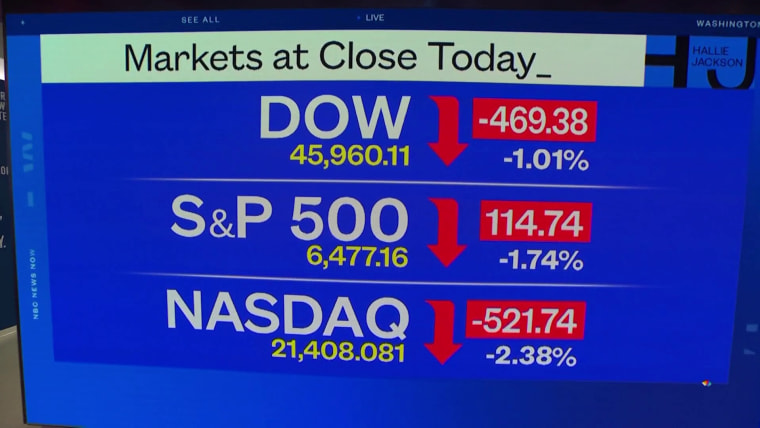
The S&P 500 closed down by 1.7%, the Dow tumbled 470 points and the Russell 2000 ended the day down 1.7%. For the S&P 500, Thursday was its worst single day since the war began.

The Nasdaq Composite fared the worst though, and dropped nearly 2.4%, pushing the index into correction territory. A correction is when an index falls 10% or more from its most recent all-time high. As of Thursday’s close, the index is now down 10.9% from its October high.

Heating oil, a proxy for jet fuel prices, also spiked 8% on Thursday afternoon. The nationwide average price of unleaded gas was $3.98 a gallon.

Nonetheless, Trump downplayed the severity of the oil and gas price spikes.

Energy prices “have not gone up as much as I thought,” Trump said at a Cabinet meeting in Washington.

The military campaign is “not over, so maybe it’ll go up a little bit more,” Trump said. “It’s all going to come back down to where it was and probably lower.”

Trump also cast doubt on a deal with Iran. “They are begging to work out a deal,” he said. “I don’t know if we’ll be able to do that. I don’t know if we’re willing to do that.”

But analysts widely believe that oil prices will continue to remain elevated over the long run, factoring in the risk that shippers will now have to assume for oil tankers that transit through the Strait of Hormuz.

Also impacting market sentiment was a report from the Organisation for Economic Co-operation and Development, which predicted that as a result of the war with Iran, the average inflation rate for G20 countries this year would rise to 4%, up from its December prediction of 2.8%. The United States is a member of the OECD.

Bonds also sold off, driving yields higher. The 10-year U.S. Treasury bond yield rose to 4.42%. The yield on 20-year bond hit 4.97% and the 30-year yield hit 4.93%.

Treasury yields, especially for the 10-year bond, heavily influence consumer lending rates. As a result, mortgage rates have risen from around 6% at the start of the war on Feb. 28 to more than 6.5% as of Thursday afternoon.

Stock indexes in Asia had already begun to sell off overnight. China’s Shanghai index and Hong Kong’s Hang Seng index both fell 1%, while Korea’s Kospi slid 3.2%.

These indexes were also weighed down by big drops in shares of tech companies, including Samsung, after Google revealed a new, more efficient use of storage and memory systems for artificial intelligence.

The Stoxx 600 in Europe followed, closing down more than 1%. Flagship stock indexes in Germany, France and the U.K. also ended the trading session down by around 1%.