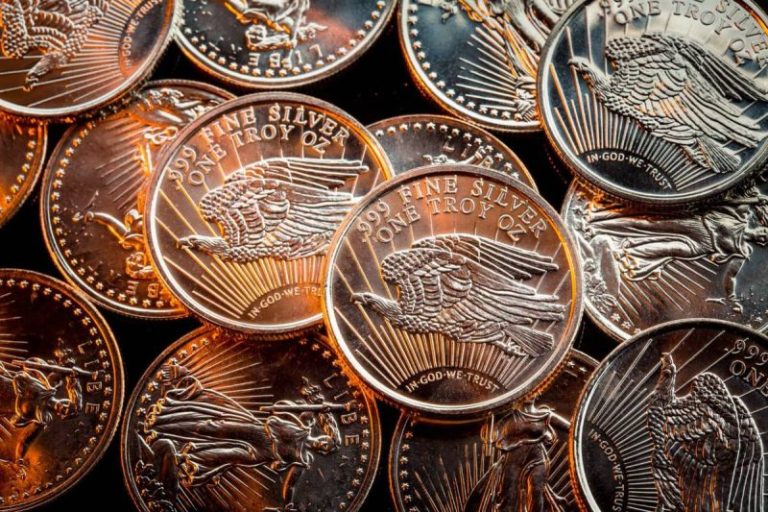
Precious metals are recovering their safe-haven demand appeal this week.
Gold, silver and platinum are up this week, all still down from the all-time highs recorded in January. Escalating geopolitical tensions and US trade policy shifts are once again at center stage in this sector of the commodities market.
Let’s take a look at what’s got the precious metals moving over the past week.
Gold price
After dropping as low as US$4,400 per ounce on February 2, this past week gold has taken another run well above the key psychological US$5,000 mark; albeit still hundreds of dollars away from its record high of close to US$5,600 reached on January 28.
After trading in a tight range of US$4,985 to US$5,000 for much of Thursday (February 19), the price of gold managed to rise as high as US$5,107 on Friday. That upward climb continued on Monday (February 23) to an intraday high of US$5,248 — a level gold hasn’t seen in a month.
The yellow metal lost that steam by Tuesday’s close with the precious metal trading back down at US$5,143. By Wednesday morning, gold was once again making a run at the US$5,200 level to reach an intraday high of US$5,217.58 at 9:10 a.m. PST. However, it couldn’t hang on for long, sinking back down to US$5,166.25 as of 1:40pm PST on profit-taking and a stronger dollar.
Gold price chart, February 18, 2026 to February 25, 2026.
Here are the primary drivers for gold this past week:
- Dips this week were brought on by slight downward pressure due to profit-taking and a stronger US dollar.
In other gold news, JPMorgan Chase (NYSE:JPM) raised its gold forecast to US$6,300 by the end of 2026, citing a ‘reserve currency paradigm shift’ as countries diversify away from the dollar, and ‘significant investor diversification’.
Looking at major events in the gold mining sector, Kinross Gold’s (TSX:K,NYSE:KGC) Great Bear development in the Red Lake district of Ontario, Canada, has been designated for a reduced permitting timeline under the provincial government’s One Project, One Process (1P1P) framework. 1P1P is a streamlined approval system aimed at reducing government review times by 50 percent. The high-grade, combined open-pit and underground operation is expected to produce more than 500,000 ounces of gold annually during its peak years.
Silver price
The price of silver is still well below its all-time high of more than US$120 per ounce it reached on January 29, 2026. For the most part, the white metal continued to track the same trends as gold this week.
Like gold, silver traded sideways Thursday (February 19) in the US$77.50 to US$78.50 range, and then surged the following day to an intraday high of US$84.61.
For most of Monday (February 23), silver continued higher but at a much slower pace, to reach as high as US$88.96. Tuesday brought another day of tight trading in the US$86.70 to US$88.10; however, by Wednesday morning the silver price had managed to break through the US$90 level on the same safe-haven demand forces pushing gold prices higher this week.
The price of silver hit an intraday high of US$91.15 at 11:55am PST before sliding back down below US$89 in the afternoon session.
Silver price chart, February 18, 2026 to February 25, 2026.
Silver may still not be back into the triple digits, but its showing strong support despite a slump in artificial intelligence (AI) tech stocks. Silver, the most electrically and thermally conductive metal on the planet, is considered a key material for AI tech, particularly in data centers and high-performance computing. Silver is also in a structural supply deficit which continues to provide upward pressure on silver prices
In silver mining news, Lundin Gold (TSX:LUG,OTCQX:LUGDF) announced a US$670 million silver stream deal with LunR Royalties (TSXV:LUNR) on its Fruta del Norte mine.
Platinum price
Platinum continues to be one of the top performing metals, reaching a 12-year high in recent weeks. This past week it has gained more than 8 percent. Sideways trading on Thursday (February 19) turned into an upward climb on Friday with prices for platinum rising from a low of US$2,060.10 to a high of US$2,117.40 per ounce.
The first few days of this new week were marked by volatility with wider price swings. The platinum price reached a three week high of US$2,226.30 in late day trading Tuesday. The jump was driven by a combination of geopolitical tensions, trade uncertainty, and structural supply constraints.
Platinum continued its ascent in overnight trading, reaching as high as US$2,360.50 in early morning trading, and managed to finish off the day just below the US$2,300 level.
Platinum price chart, February 18, 2026 to February 25, 2026.
Platinum prices are benefitting from renewed tariff jitters, geopolitical safe-haven demand, and persistent supply tightness from major producer South Africa.
The emerging hydrogen economy is also adding to demand for the metal on top of robust demand from the auto sector. Consumers are shifting back toward internal combustion engine and diesel vehicles as hurdles to EV adoption remain challenging. This is highly supportive of demand for platinum as its primary use is in automotive catalysts.
On the supply side, global platinum reserves remain critically low, especially as the world’s biggest producer South Africa continues to be plagued by power shortages and operational disruptions.
In platinum mining news, Valterra Platinum declared a dividend of 45 rand a share for a total 2025 payout of 12 billion rand (US$757 million) after its net income more than doubled to 15.4 billion rand. Bloomberg reported that the size of the dividend “smashed analyst expectations as earnings jumped last year on soaring metals prices”.
Palladium price
Palladium has been the black sheep of the precious metals family for the past few years, remaining well below its March 2022 all-time record of US$3,440.76 per ounce.
On Thursday (February 19), unlike its sister metals, palladium rallied 4.8 percent to an intraday high of US$1,767.50. The metal closed out last week with another nearly 3.9 percent gain to US$1,836.
On Monday, palladium lost some of that ground to close out the day at US$1,820. After dipping to a low of US$1,763 in early morning trading on Tuesday, the price of the metal regained those losses and more by the end of the trading day reaching as high as US$1,843.
Wednesday (February 25) morning brought a spike in palladium prices to US$1,935 as the metal went along for the same ride as platinum, before falling back to the US$1,860 level in afternoon trading.
Palladium price chart, February 18, 2026 to February 25, 2026.
As is the case with platinum, demand for palladium is getting support from the auto sector. Rising prices for platinum are leading automakers to make the swap to palladium.
The US Department of Commerce’s preliminary statement of support for anti-dumping duties of approximately 133 percent on unwrought Russian palladium imports is still shaping the outlook for palladium on the supply side. This follows a petition from Sibanye-Stillwater (NYSE:SBSW) over allegations that Russian metal is being sold in the US at less than fair value. A final decision is expected in the case by June of this year.
Securities Disclosure: I, Melissa Pistilli, hold no direct investment interest in any company mentioned in this article.
This post appeared first on investingnews.com